
Introduction
In industries such as oil & gas, offshore energy, construction, and industrial maintenance, accessing elevated or hard-to-reach locations remains a constant challenge. Traditional methods like scaffolding and heavy lifting equipment are often costly, time-consuming, and lack flexibility.
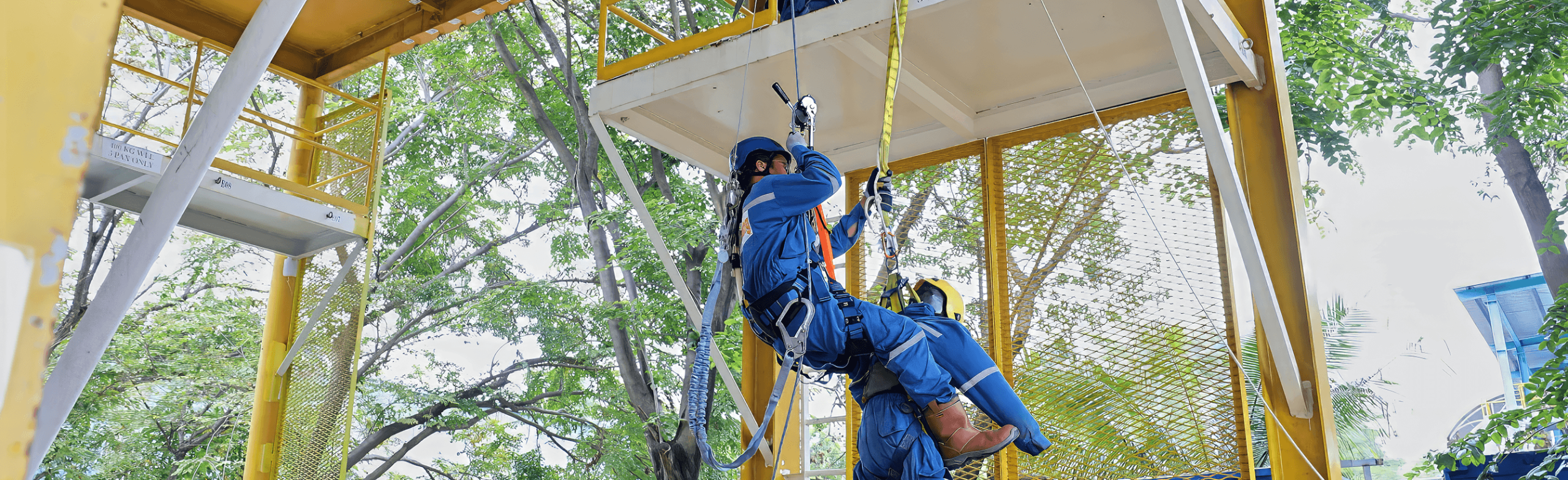
Rope Access, certified under the globally recognized IRATA (Industrial Rope Access Trade Association) standard, offers a safer, faster, and more efficient solution.
Course Objective
This program equips participants with the skills and competencies required for certification across three IRATA levels:
-
- Rope Access Level 1 (Entry Level)
- Rope Access Level 2 (Intermediate Level)
- Rope Access Level 3 (Advanced / Supervisory Level)
With structured progression across all three levels, the course supports career development and advancement within the rope access industry.
Courses are conducted monthly, with each training lasting 5 days. Early booking is recommended due to limited availability. Revalidation and refresher courses are also available to ensure continued compliance with IRATA standards.
IRATA Level 1 – Entry Level
Designed for candidates with no prior experience.
At this level, the focus is on building a strong foundation:
-
- Performing basic rope access tasks (ascending, descending, transfers)
- Strict adherence to safety procedures
- Working under direct supervision of a Level 3 supervisor
Key emphasis:
-
- Correct techniques
- Safe working habits
- Understanding rope access systems in real environments
Training content includes:
-
- Rope movement techniques (ascent, descent, changeovers)
- Rope-to-rope transfers and knot passing
- Traversing and aid climbing
- Passing re-anchors and deviations
- Use of backup systems
- Basic rigging and rope management
IRATA Level 2 – Intermediate Level
For candidates holding a valid IRATA Level 1 certificate with a minimum of 1,000 logged working hours.
At this stage:
-
- Transition from learning to execution
- Increased independence in operations
- Ability to perform complex rigging and assist in rescue scenarios
Key distinction:
-
- Not only following procedures
- But understanding and adapting them to real operational conditions
IRATA Level 3 – Advanced / Supervisory Level
For candidates holding a valid IRATA Level 2 certificate with a minimum of 1,000 logged working hours in Level 2
This level represents a shift to leadership and safety-critical responsibility.
A Level 3 technician is responsible for:
-
- Planning rope access operations
- Conducting risk assessments
- Ensuring compliance with safety standards
- Supervising the entire team
- Designing safe systems of work
- Managing complex rescue scenarios
Most importantly, the Level 3 holds full responsibility for the safety of all personnel on site.
Prerequisites
-
- Valid IRATA Logbook demonstrating required working hours
- Appropriate work boots and climbing clothing
- Valid photo ID (passport, ID card, or driving licence)
- Good physical condition and fitness, with no medical limitations that could affect safe working at height
Course Duration
-
- 4 days of practical training
- 1 day of assessment
Training at PVD Training
IRATA courses at PVD Training are delivered with a strong focus on practical competence and real-world application.
Participants benefit from:
-
- Modern training facilities simulating real working conditions
- Experienced instructors with strong industry backgrounds
- Training aligned with IRATA International standards
Our goal is not only certification, but ensuring participants are fully prepared for real operational environments.
Assessment
-
- Conducted on Day 5
- Format: Pass / Fail
Candidates who do not pass may re-sit the assessment within 60 days from the initial attempt.