
GWO Advanced Rescue Training (ART)
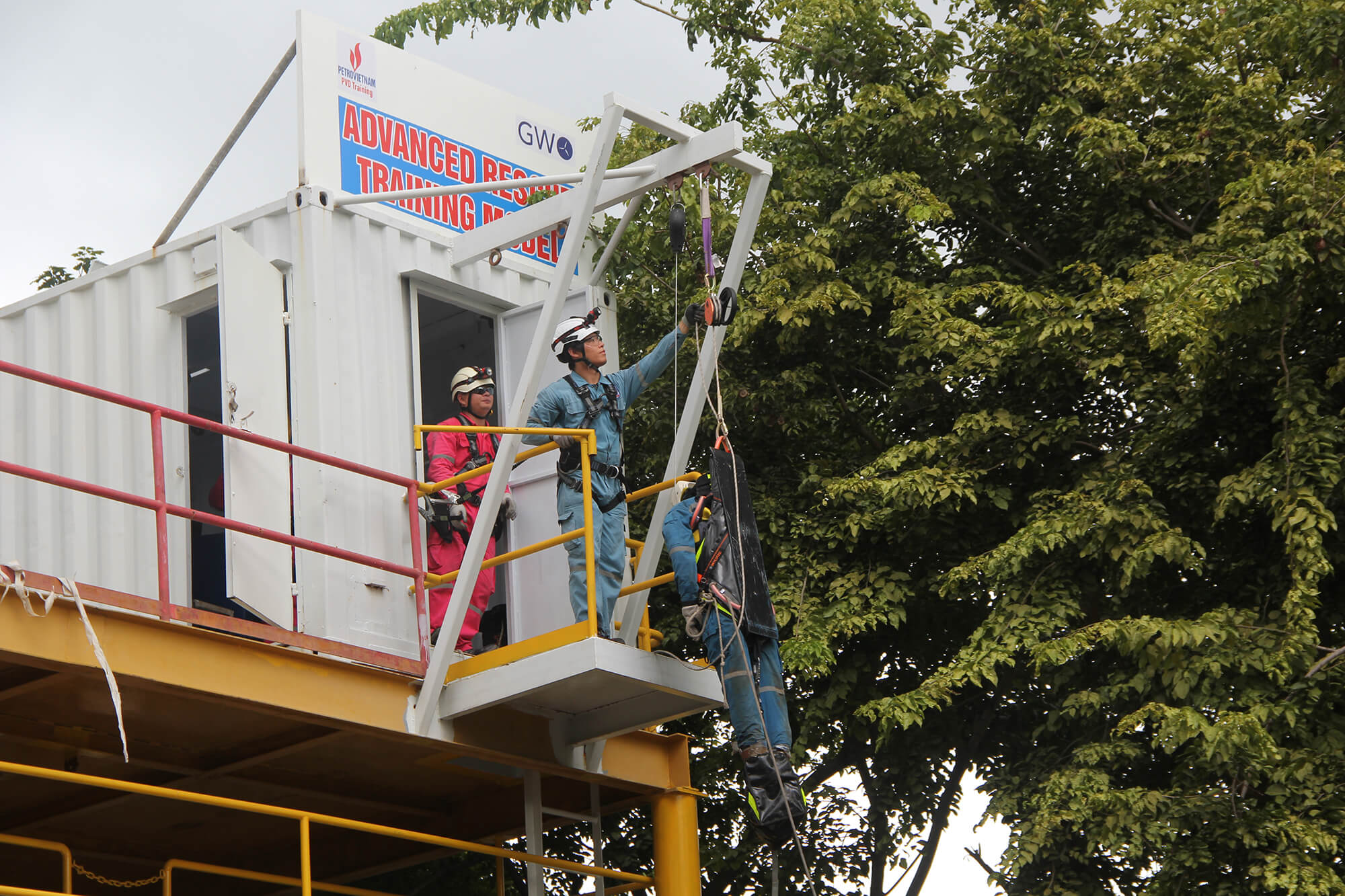
The GWO Advanced Rescue Training (ART) is designed to provide participants with the knowledge and skills to perform advanced rescue operations within a wind turbine environment.
This training builds upon the competencies gained in GWO Basic Safety Training (BST), particularly Working at Height, and focuses on performing rescue operations using industry-standard equipment, methods, and techniques.
The ART standard is structured in modules, allowing participants to complete one or more modules depending on their operational requirements.
TARGET GROUP
The GWO Advanced Rescue Training (ART) is intended for personnel who:
- Work in the wind industry or related fields
- Have duties in a wind turbine environment
- May be required to perform advanced rescue or lead rescue operations
- Are selected by their employer to mitigate identified risks through advanced rescue training
Participants are expected to have prior knowledge and skills equivalent to GWO Working at Height (BST).
AIMS AND OBJECTIVES
The aim of the GWO Advanced Rescue Training (ART) is to enable participants to perform advanced rescue operations in wind turbine environments.
Upon completion of the training, participants will be able to:
- Perform rescue operations using relevant equipment and techniques
- Apply industry-accepted rescue methods in turbine-specific scenarios
- Demonstrate safe working practices during rescue operations
- Perform rescue operations at height and in confined areas within wind turbines
- Manage risks associated with rescue activities
The training emphasizes practical application of rescue techniques in realistic scenarios.
COURSE MODULES
The GWO Advanced Rescue Training (ART) is delivered as modular training. Participants may complete one or more of the following modules:
- Hub, Spinner and Inside Blade Rescue (HSIBR)
Covers rescue operations in restricted and confined areas within the hub, spinner, and inside turbine blades. - Nacelle, Tower and Basement Rescue (NTBR)
Focuses on rescue scenarios within the nacelle, tower, and basement areas of a wind turbine. - Single Rescuer: Hub, Spinner and Inside Blade Rescue (SR-HSIBR)
Provides training for performing rescue operations as a single rescuer in hub and blade environments. - Single Rescuer: Nacelle, Tower and Basement Rescue (SR-NTBR)
Focuses on single rescuer techniques in nacelle, tower, and basement rescue scenarios.
Each module includes theoretical instruction and practical exercises, conducted in accordance with GWO requirements.
DURATION
The total contact time for completing the full Advanced Rescue Training (ART) standard is approximately:
- 30 hours and 55 minutes (excluding meals and breaks)
Module durations are defined within the GWO standard and must be delivered in accordance with prescribed training times.
The maximum training duration per day shall not exceed:
- 8 hours of contact time
- 10 hours total training day (including breaks and logistics)
VALIDITY
The validity of GWO Advanced Rescue Training (ART) is module-specific:
- Hub, Spinner and Inside Blade Rescue (HSIBR) – Valid for 24 months
- Nacelle, Tower and Basement Rescue (NTBR) – Valid for 24 months
- Single Rescuer Modules (SR-HSIBR & SR-NTBR) – No expiry (enduring qualification)
Training records must be renewed prior to expiry to maintain certification validity.
If certification expires, participants must complete the relevant ART module again to obtain a new training record.
All records are maintained in the GWO WINDA system, where validity is automatically calculated based on the completion date.
FITNESS
Participants must be physically and medically fit to complete all aspects of the training.
The course includes physically demanding activities such as:
- Working at height
- Climbing and rescue exercises
- Handling rescue equipment
Participants are required to complete a medical declaration prior to training.